
The global maritime fleet forms the backbone of international trade, transporting more than 80% of goods across oceans. In South Africa, the Port of Durban alone is one of the busiest on the African continent, serving as a critical hub for the region’s imports and exports. With vessels constantly exposed to saltwater corrosion, dynamic wave loading, cavitation, and continuous mechanical stress, ship repair is far more than routine upkeep—it is a highly specialized engineering discipline.
South African ship repair is governed by a complex framework of international regulations (SOLAS, MARPOL, ISM Code), classification society requirements (Lloyd’s Register, Bureau Veritas, ABS, DNV, and others), and national legislation enforced by the South African Maritime Safety Authority (SAMSA) under the Merchant Shipping Act (1951, as amended). Compliance with these standards ensures that vessels remain seaworthy, environmentally responsible, and operationally efficient.
Key Areas of Ship Repair
1. Hull Repairs
The ship’s hull is its primary defense against the ocean, and structural failures can compromise buoyancy and stability. In South Africa, repairs are typically executed under SAMSA surveyor oversight and in accordance with IACS Unified Requirements:
- Steel Renewal: Crop and renew techniques involve removing wasted plating, beveling edges, and welding new steel inserts with consumables meeting AWS D1.1 or EN ISO 15614 standards.
- Welding & NDT: Full penetration welds are subject to ultrasonic and radiographic testing, ensuring compliance with ISO 9712 NDT requirements.
- Surface Preparation: Abrasive blasting is performed to ISO 8501-1 Sa 2.5 or higher, followed by epoxy coating systems aligned with IMO PSPC (Performance Standard for Protective Coatings) to resist corrosion in ballast tanks and cargo holds.
2. Propulsion Systems
The propulsion train is critical to vessel performance and fuel efficiency. Misalignment or bearing wear can result in vibration, increased fuel consumption, and catastrophic failure:
- Shaft Line Surveys: Clearances and wear-down readings are measured against OEM tolerances and ISO 21079 alignment standards.
- Stern Tube Bearings: Lubrication checks, oil sampling for metal particle content, and white-metal bearing inspections are carried out, with clearances measured using feeler gauges or laser alignment systems.
- Propeller Balancing: Dynamic balancing is conducted per ISO 1940-1 G6.3, reducing cavitation risk and ensuring vibration levels remain below ISO 10816 acceptance criteria.
3. Engines & Machinery
Marine engines must comply with both performance expectations and emissions regulations (MARPOL Annex VI). South African workshops are increasingly certified for in-situ machining, allowing high-precision work without full dismantling:
- Crankshaft Machining: Journal machining tolerances are restored to within ±0.02 mm, with hardness verified by Brinell testing.
- Cylinder Liner Honing: Honing restores cross-hatch patterns essential for oil retention, with roughness measured to Ra 0.2–0.4 μm.
- Turbocharger Balancing: Rotors are balanced on high-speed rigs to within ISO 1940-1 G2.5, preventing overspeed failures.
- Emission Compliance: Exhaust gas analyzers are used to confirm compliance with MARPOL Annex VI NOx Technical Code (2008), a requirement SAMSA enforces for vessels entering South African waters.
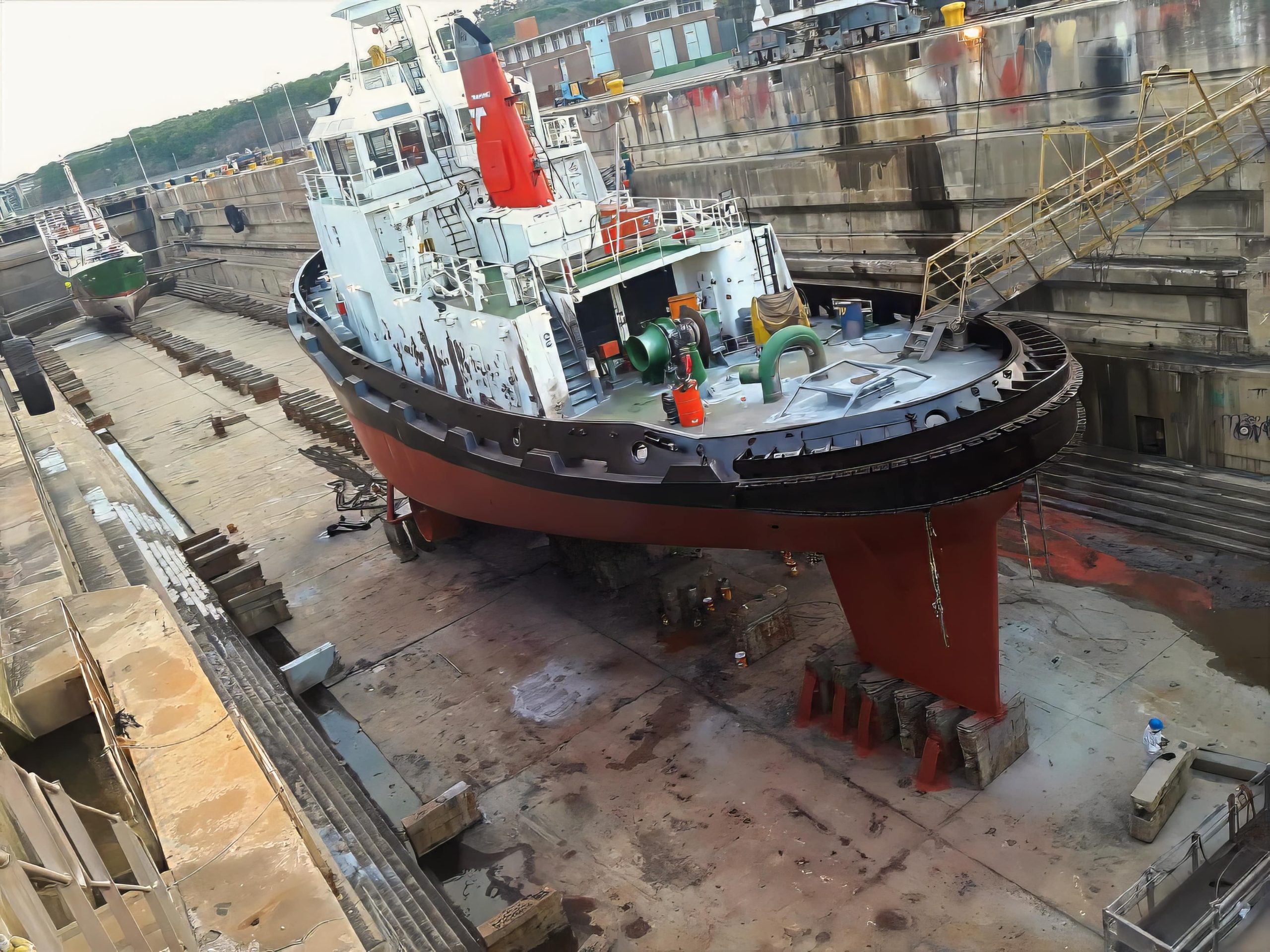
4. Dry Docking & Surveys
Dry docking is a logistical and engineering challenge, requiring precise calculations and strict survey protocols:
- Docking Block Calculations: Blocks are laid out based on vessel hydrostatic data, ensuring weight distribution prevents hull stress or damage.
- Ultrasonic Thickness Gauging: Conducted per ISO 17643, UT gauging identifies wastage patterns in shell plating, tank boundaries, and critical load-bearing structures.
- Class Surveys: In South Africa, SAMSA-approved surveyors work alongside Class surveyors to conduct Annual, Intermediate, and Special Surveys, including Enhanced Survey Program (ESP) for bulk carriers and tankers.
- Environmental Controls: Dockyards comply with South African environmental legislation (NEMA, 1998) for waste management, bilge water handling, and blasting grit recovery.
Safety & Compliance in the South African Context
South African ship repair practices integrate both global best practices and local legal obligations:
- Merchant Shipping Act (1951, as amended): Provides the statutory basis for safety and operational compliance.
- SAMSA Marine Notices: Regular updates mandate new safety, environmental, and crew welfare requirements.
- Occupational Health & Safety Act (1993): Ensures safe working environments for repair crews, with strict guidelines on confined space entry, hot work permits, and PPE standards.
- Broad-Based Black Economic Empowerment (B-BBEE): Encourages local workforce development, ensuring the South African ship repair sector supports national transformation goals.
Conclusion
Ship repair merges naval architecture, metallurgy, precision machining, and marine engineering into a discipline that safeguards not only vessels but also the lifeblood of global commerce. In South Africa, the combination of world-class facilities, highly skilled engineers, and stringent regulatory oversight ensures that vessels leaving local dry docks are compliant, reliable, and efficient.
Downtime in shipping translates directly to lost revenue. Precision-driven ship repair, aligned with SAMSA regulations and international Class standards, ensures that global trade stays afloat—with South Africa positioned as a strategic repair and maintenance hub on the East-West shipping routes.