
Dry docking is a cornerstone of ship maintenance, providing the opportunity to inspect, repair, and certify a vessel’s submerged structure in a controlled environment. It is not simply a maintenance routine, but a class-mandated requirement tied directly to a ship’s safety, seaworthiness, and commercial certification.
In South Africa, dry docking activities fall under the South African Maritime Safety Authority (SAMSA) and must conform to international class society regulations such as Lloyd’s Register (LR), DNV, Bureau Veritas (BV), American Bureau of Shipping (ABS), and ClassNK. Compliance ensures that vessels remain fully certified for trading worldwide under the standards set by the International Maritime Organization (IMO).
Technical Procedures
1. Pre-Docking Preparation
Before a vessel enters dry dock, thorough planning and documentation are required.
- Docking Plans: The ship’s docking plan, including block positions and load distribution, is submitted to the dock master.
- Risk Assessments: Detailed hazard and operability studies (HAZOP) cover flooding, lifting, and fire safety.
- Work Scopes: Owners and class societies agree on inspection and repair items, including statutory surveys.
- Logistics: Ballast, fuel, and cargo planning ensures safe docking stability.
2. Docking and Safety Controls
Safe entry into the dock is a precision operation.
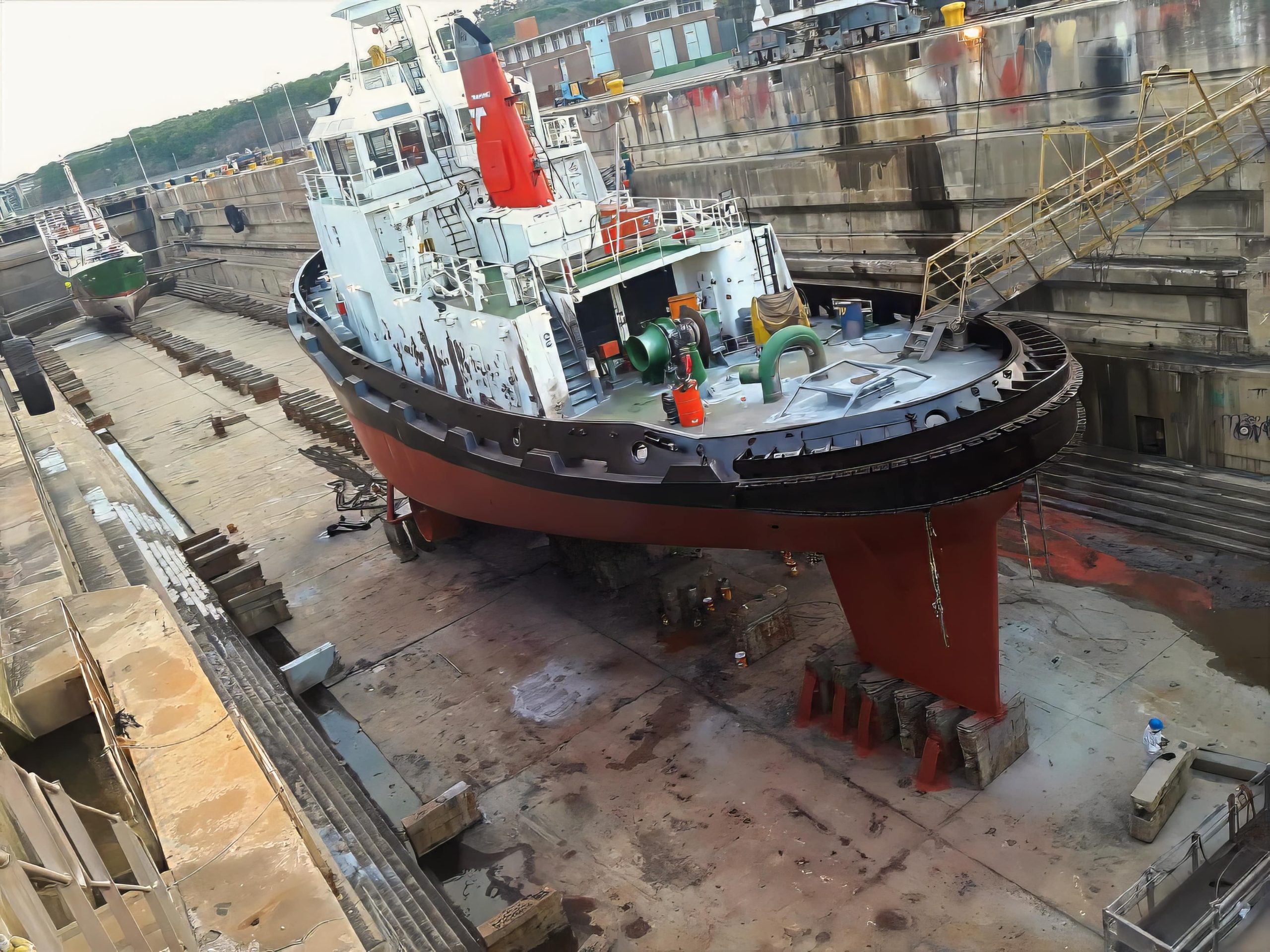
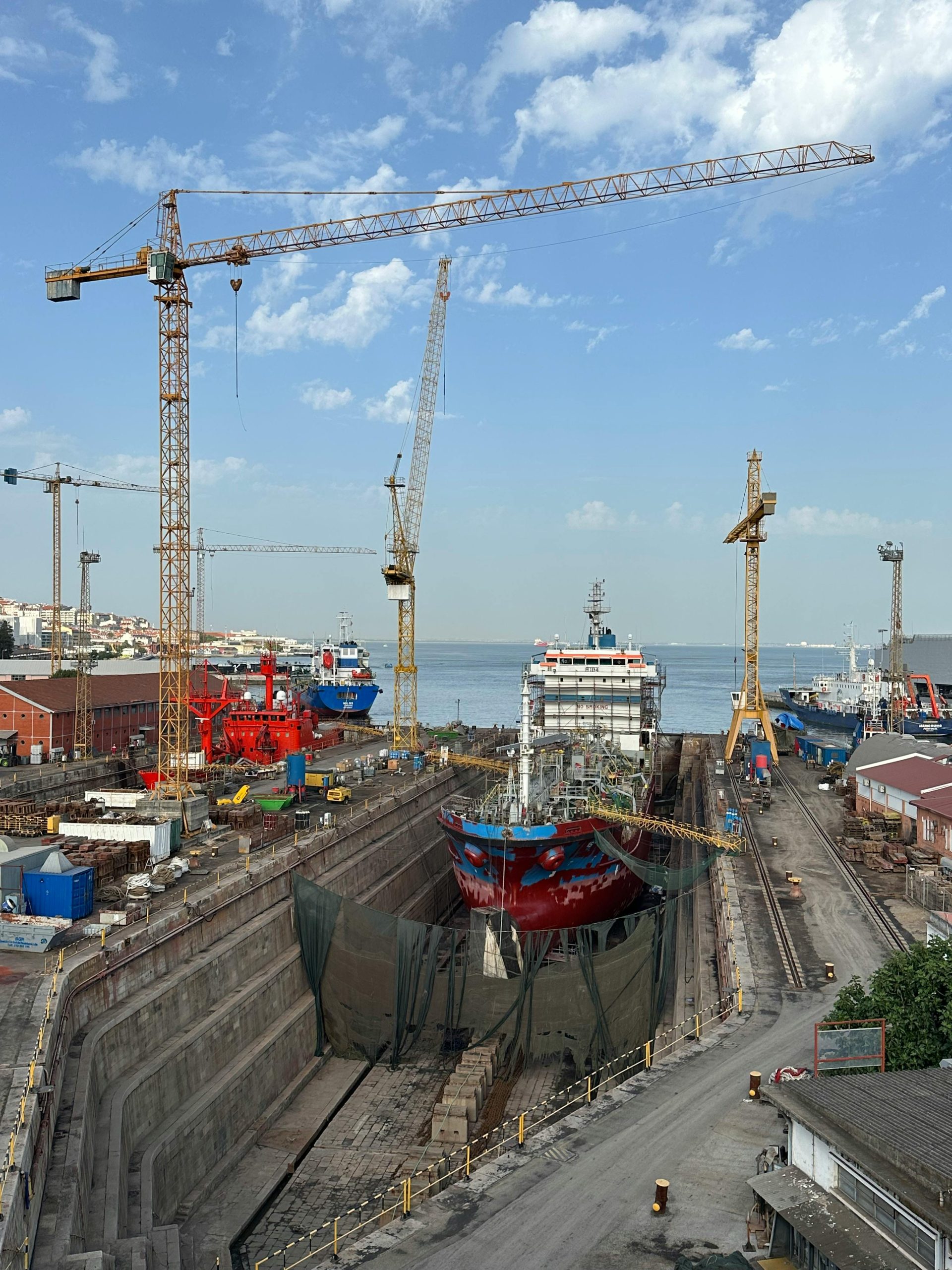
- Docking Maneuver: The vessel is guided into the dock with tug assistance, using mooring winches for alignment.
- Block Positioning: Keel and bilge blocks are aligned per the ship’s docking plan to avoid hull distortion.
- Pumping Out: The dock is dewatered in stages while stability, trim, and stresses are monitored.
- Safety Standards: Docking operations comply with SAMSA safety guidelines and ILO dockworker safety codes.
3. Hull and Structural Inspections
Once the vessel is dry, structural integrity and protective systems are assessed.
- Hull Survey: Ultrasonic thickness measurements (UTM) of shell plating, particularly in high-stress areas.
- Cathodic Protection: Sacrificial anodes are replaced and impressed current systems checked.
- Sea Chests & Valves: Inspection, cleaning, and pressure testing in compliance with class society rules.
- Propeller & Rudder: NDT on rudder stocks, stern bearings, and propeller blade polishing or crack testing.
4. Machinery & Systems Overhaul
Dry docking is also the opportunity to overhaul underwater and auxiliary machinery.
- Stern Tube & Seals: Bearing clearance checks and seal replacement under class supervision.
- Thrusters & Shafts: Overhaul and reinstallation with laser alignment verification.
- Piping Systems: Renewal of sea water lines, bilge systems, and overboard discharges to MARPOL standards.
- Firefighting & Safety Equipment: Inspection and renewal as per SOLAS Chapter II-2 requirements.
5. Coating & Corrosion Protection
Surface preparation and coatings safeguard hull efficiency and longevity.
- Blasting & Painting: Hull preparation to ISO 8501-1 Sa 2.5 followed by high-performance coatings.
- Anti-Fouling Systems: Application of IMO-approved biocidal or silicone-based foul release systems.
- Tank Coatings: Cargo, ballast, and fuel tanks inspected and re-coated in compliance with class-approved cycles.
6. Class Society & Regulatory Compliance
Every dry docking is tied to formal survey regimes defined by the class societies.
- Intermediate & Special Surveys: Class rules require 2.5-year intermediate and 5-year special surveys.
- Statutory Inspections: Surveys cover Load Line Convention, SOLAS, MARPOL, and ISM Code compliance.
- Documentation: Data books include NDT reports, pressure test certificates, coating thickness logs, and repair records.
- Certification: Upon successful completion, class endorses the ship’s certificates, extending its trading validity.
Conclusion
Dry docking is not a discretionary activity—it is a regulatory requirement that blends engineering, safety, and compliance. By following strict procedures under class society oversight, owners ensure that their vessels remain efficient, compliant, and ready for global trade.
For ship operators, the value lies in reliability: reduced risk of structural failure, extended hull life, and uninterrupted trading status. In today’s competitive shipping market, dry docking done to class-approved standards is both a legal necessity and a commercial advantage.